
Monash Automations

Project Engineer | Jul 2025 - Present

Monash Automations is a student team that takes in industry projects and develops solutions for them. As a Project Engineer, I have gained valuable experience in PCB design, 3D CAD Design, and AI training and development. Additionally, I have led a project myself, improving my management skills.

Some of the key responsibilities and achievements in this role include:

  • Designing and developing PCBs for various automation projects.
  • Creating 3D CAD models for prototypes and final products.
  • Training AI models to enhance automation capabilities.
  • Leading a project team, coordinating tasks, and ensuring timely delivery of project milestones.

Some of my projects include:

  • 3D Printer Error Detection System Using Artificial Intelligence
  • Rehabilitation glove for stroke victim

AI powered 3D Printer Error Detection System

Project Lead
Overview

An automated vision-based system designed to detect 3D printing failures in real time and prevent wasted material, time, and operational costs. Camera sensors were deployed across a 3D printer farm to continuously monitor print progress. Images were periodically captured via a Raspberry Pi and passed through a deep learning model to classify print failures. Once a failure was confirmed, the system communicated directly with Prusa XL printers through a REST API to pause or cancel the print automatically.

Technical Approach
  • Periodic image polling of active prints using Raspberry Pi–connected cameras
  • Failure classification using a ResNet-18–based CNN
  • Automated printer control via PrusaLink's REST API
  • Endoscopic nozzle monitoring for close-range failure detection
My Contributions
  • Customised the ResNet-18 architecture in PyTorch to suit the specific failure classification task
  • Designed and implemented the end-to-end training pipeline, using datasets of up to 10,000 labelled images
  • Deployed a webcam server to stream an endoscope view of the printer nozzle for enhanced fault visibility
Impact and Outcomes
  • Reduced failed print runtime and material waste
  • Enabled autonomous intervention without human supervision
  • Improved reliability and scalability of printer farm operations
Stroke Rehab Glove

Project Engineer
Overview

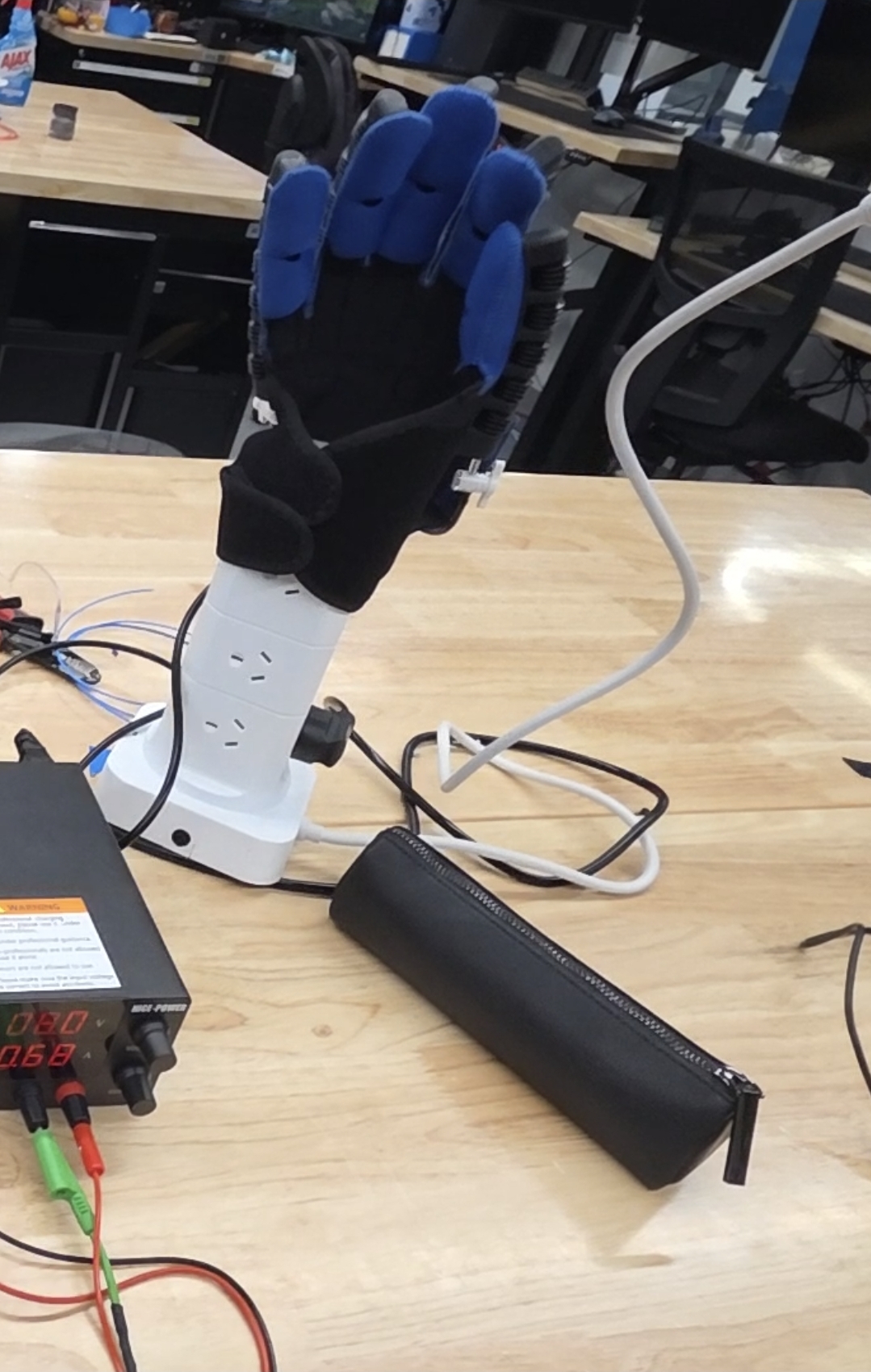
In Australia, nearly 50,000 people are affected by stroke each year, with many experiencing partial or complete loss of hand mobility. This project aims to improve the accessibility and affordability of stroke rehabilitation gloves designed to reduce spasticity and support the rebuilding of neural pathways responsible for hand control. Inspired by the Syrebo rehabilitation glove, we are developing a custom controller and rehabilitation program tailored for flexible, software-driven therapy. The project is currently in Phase 1, focused on proof-of-concept development.

Technical Approach
  • Reverse engineering of a commercially available Syrebo rehabilitation glove
  • Mechanical modification of the glove to improve finger dexterity and range of motion
  • Design and development of a custom controller
  • Integration with a microcontroller to enable programmable and adaptive rehabilitation routines
My Contributions
  • Disassembled and analysed the original Syrebo controller hardware
  • Used laboratory equipment, including oscilloscopes and multimeters, to characterise signals and support reverse engineering
  • Designed and built a custom controller, enabling full software control of the glove via a microcontroller